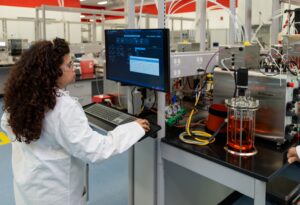
A bench-scale upstream setup at Thermo Fisher’s Bioprocess Design Center. (Credit: Thermo Fisher Scientific)
Thermo Fisher Scientific has spent the past year signing a string of AI partnerships that make fully autonomous labs sound close at hand, including collaborations with NVIDIA on AI-connected instruments and a separate tie-up with OpenAI. Natraj Ram, the company’s vice president of innovation, offers a more measured read on what those deals can deliver in the near term.
In the following Q&A, Ram discusses where AI is likely to show measurable value first (documentation, decision support, and clinical research, ahead of the wet lab). He expands on AI “co-scientists,” governed tool users that depend on curated data and AI standards like MCP. He shares what has to come together technically before instruments can run autonomously in routine workflows and how Thermo Fisher’s Plainville, Massachusetts, bioprocess facility informs his case for designing processes with manufacturing in mind from the start.
Ram leads innovation strategy at Thermo Fisher. In this role, he sets the roadmaps for new products, technologies and services. He came to the role after senior positions at Pfizer, Takeda and AbbVie, with hands-on experience spanning cell-line development, upstream and downstream process development, analytical development, validation and clinical and commercial manufacturing. He holds a Ph.D. in chemical and biochemical engineering from Rutgers University.
Across Thermo Fisher’s work in bioproduction, clinical research, lab automation and instrumentation, where is the biggest gap between what science can imagine and what labs can reliably execute?
Ram: The biggest gap is not scientific capability. It is our ability to connect knowledge, data and decisions across the entire lifecycle. Today, we can imagine a future where insights generated during discovery inform clinical development, manufacturing and quality decisions in a continuous loop. The value comes from connecting what we learned in the past with what we are doing today and using that knowledge to accelerate decisions and outcomes.

Natraj Ram
What limits execution is that the underlying data, systems and workflows are still fragmented. Information often resides in separate platforms, organizations and stages of development. To close the gap, we need infrastructure that can integrate prior knowledge, connect data across functions and support faster, more informed decision-making. That connected ecosystem is what can unlock the full potential of automation and AI in science.
Given the NVIDIA and OpenAI collaborations, where do you expect AI’s earliest measurable impact: trial design, protocol execution, manufacturing, instrument operation, documentation or decision support?
Ram: AI will have the earliest measurable impact in areas where it augments human expertise rather than independently making critical decisions. In the near term, we see opportunities in scientific discovery, clinical research and decision support, where AI can help accelerate target identification, improve protocol design, optimize site selection and streamline trial execution. Documentation is a natural starting point because AI can efficiently synthesize large volumes of information, generate drafts and improve productivity while still allowing human review and approval. Instrument operation and workflow guidance are also promising near-term opportunities, particularly when AI can monitor conditions, identify anomalies and provide recommendations.
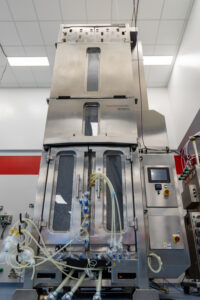
A Thermo Scientific DynaDrive single-use bioreactor, the kind of large-volume system that anchors the scale-up question of whether a bench process transfers cleanly to manufacturing. (Credit: Thermo Fisher Scientific)
As we move further toward design and decision support, the requirements become more stringent. Scientific and patient-related decisions require consistency, traceability and confidence. The challenge is ensuring AI outputs are reliable, traceable and governed within validated workflows by grounding them in validated knowledge, domain expertise and governance frameworks.
Manufacturing environments require rigorous validation and reliability, but AI is already creating opportunities to improve operational efficiency, instrument performance and process execution.
Over time, AI will help researchers identify more promising candidates and accelerate the experimental validation needed to advance them, improving R&D productivity and scientific outcomes.
What’s your take on AI “co-scientists”? Are we shifting toward more structured systems built on governed tools, metadata and validated data, and what role do standards like MCP play?
Ram: I do believe we are moving toward AI systems that function as scientific collaborators, but only if they are built on governed data, validated knowledge and trusted workflows. In science, reliability and repeatability matter as much as intelligence. An effective AI system must have access to curated data, appropriate metadata and robust controls to help ensure it produces consistent and defensible results.
In many ways, the industry’s biggest challenge is not AI itself but the quality and accessibility of the underlying data. Organizations first need to address fragmented data environments and establish trusted sources of information. Standards such as MCP become valuable because they allow AI agents to use tools, access relevant information and connect systems in a structured way. I see AI less as a standalone knowledge engine and more as a highly capable tool user that can bring together information from multiple validated sources.
Thermo Fisher and NVIDIA have described AI-connected instruments and lab infrastructure. What has to happen technically before instruments can run more autonomously in routine workflows?
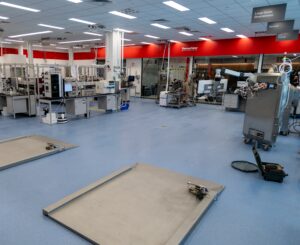
The Bioprocess Design Center floor in Plainville, Massachusetts, where workflow stages are co-located under zone markers including upstream small scale, harvest, large-scale downstream, analytics and cell therapy. This is the proximity Ram credits with helping scientists design processes with manufacturing in mind. (Credit: Thermo Fisher Scientific)
Ram: Autonomous instruments require much more than AI models. They require large amounts of curated training data, clear operational knowledge and systems that can explain and validate their actions. Similar to autonomous driving, the intelligence comes from extensive data, testing and real-world experience, not simply from software alone. We believe there will be increasing levels of automation and autonomy in well-defined workflows, with appropriate human oversight, validation and governance.
For scientific instruments, three elements must come together: the physical operation of the instrument, real-time awareness of what is happening during the process, and the scientific knowledge needed to make appropriate adjustments. Only when those components are integrated and trained on high-quality data can instruments become increasingly autonomous while maintaining the reliability required in regulated environments.
Where is lab automation most mature today, and where are scientists still doing surprisingly manual work?
Ram: Today, lab automation is most mature at the individual instrument level. Many systems can already execute predefined workflows, follow rules-based procedures and respond to specific inputs in a highly repeatable way. These capabilities have delivered significant productivity gains within individual processes.
The larger opportunity lies in connecting workflows across instruments, laboratories and process steps. Scientists still spend considerable time moving samples, preparing materials, transferring data between systems and coordinating activities across multiple pieces of equipment. In many analytical workflows, these handoffs remain surprisingly manual. Automating those end-to-end workflows has the potential to create much greater efficiency, but it also requires careful validation and governance to help ensure data integrity and scientific accuracy.
Increasingly, customers are looking to connect data, instruments and workflows across discovery, development and manufacturing so they can make faster, more informed decisions.
Plainville co-locates media, cell-line development, single-use systems, chromatography, filtration, purification, analytics, viral-vector manufacturing and fill-finish. Where do customers most often discover that a process which ran well at bench scale won’t transfer cleanly to manufacturing, what data do you wish they’d captured earlier, and how does the facility shape your thinking on lab layout and automation?
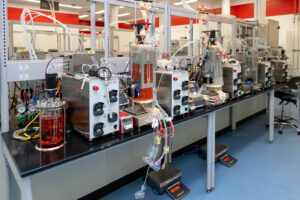
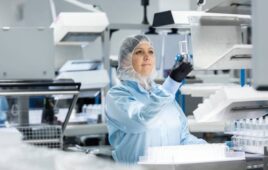
A scientist monitors a bioreactor run from a control station at the Bioprocess Design Center, the human-in-the-loop oversight Ram describes as essential before instruments become more autonomous. (Credit: Thermo Fisher Scientific)
Ram: One of the most common challenges is that a process developed at bench scale was never designed with manufacturing in mind. Researchers often optimize around what works in the laboratory, but manufacturing operates under very different constraints involving scale, equipment, controls and reproducibility. The result is that a process that performs well in a small setting can become difficult to transfer or scale efficiently.
The most important principle is to start with the end in mind. Scientists should understand the realities of manufacturing early in development and design processes that reflect how they might be executed at scale. Capturing process parameters, control strategies and operational assumptions early can significantly reduce comparability challenges later.
Facilities such as our Bioprocess Design Center in Plainville, Massachusetts help create that connection by bringing development, manufacturing and analytical capabilities together. Co-location encourages knowledge exchange, helps scientists understand manufacturing requirements and enables manufacturing teams to engage with emerging technologies earlier. That feedback loop is essential for creating scalable and transferable processes.
Industry polling suggests AI has delivered more value in regulatory and reporting workflows than at the bench. What has to change for AI to become useful in the wet lab: cleaner data, better instrument integration, workflow software, more reliable agents or clearer validation standards?
Ram: AI has delivered early value in regulatory and reporting workflows because large language models are inherently strong at working with text, language and documentation. Applying those same capabilities to experimental science is a more complex challenge because success depends on translating knowledge into physical actions and real-world execution.
To make AI truly useful at the bench, we need progress across all the areas mentioned: cleaner data, stronger instrument integration, better workflow orchestration, more reliable agents and clearer validation frameworks. Underlying all of these is the need for digital infrastructure that connects data, systems and knowledge in a consistent way.
The encouraging trend is that AI has created a compelling business case for investment in digital infrastructure across the life sciences industry. As organizations improve data quality, integrate systems and formalize knowledge, AI will be able to deliver increasing value in laboratory and manufacturing environments. The opportunity is significant, and the pace of progress is likely to accelerate as those foundational capabilities mature.




Tell Us What You Think!